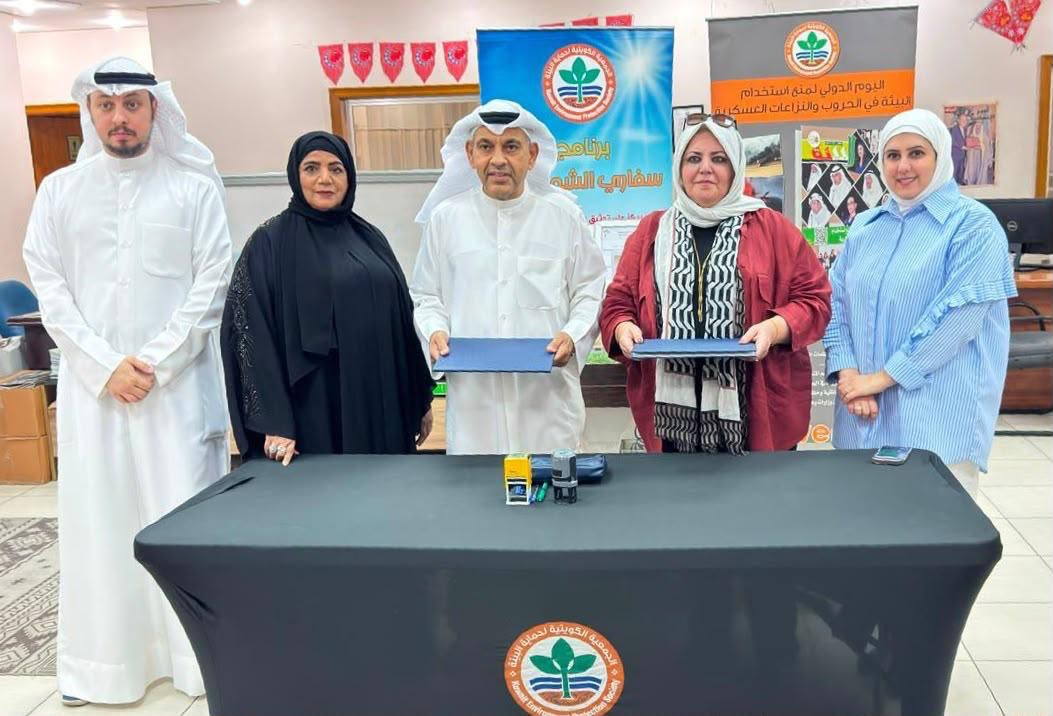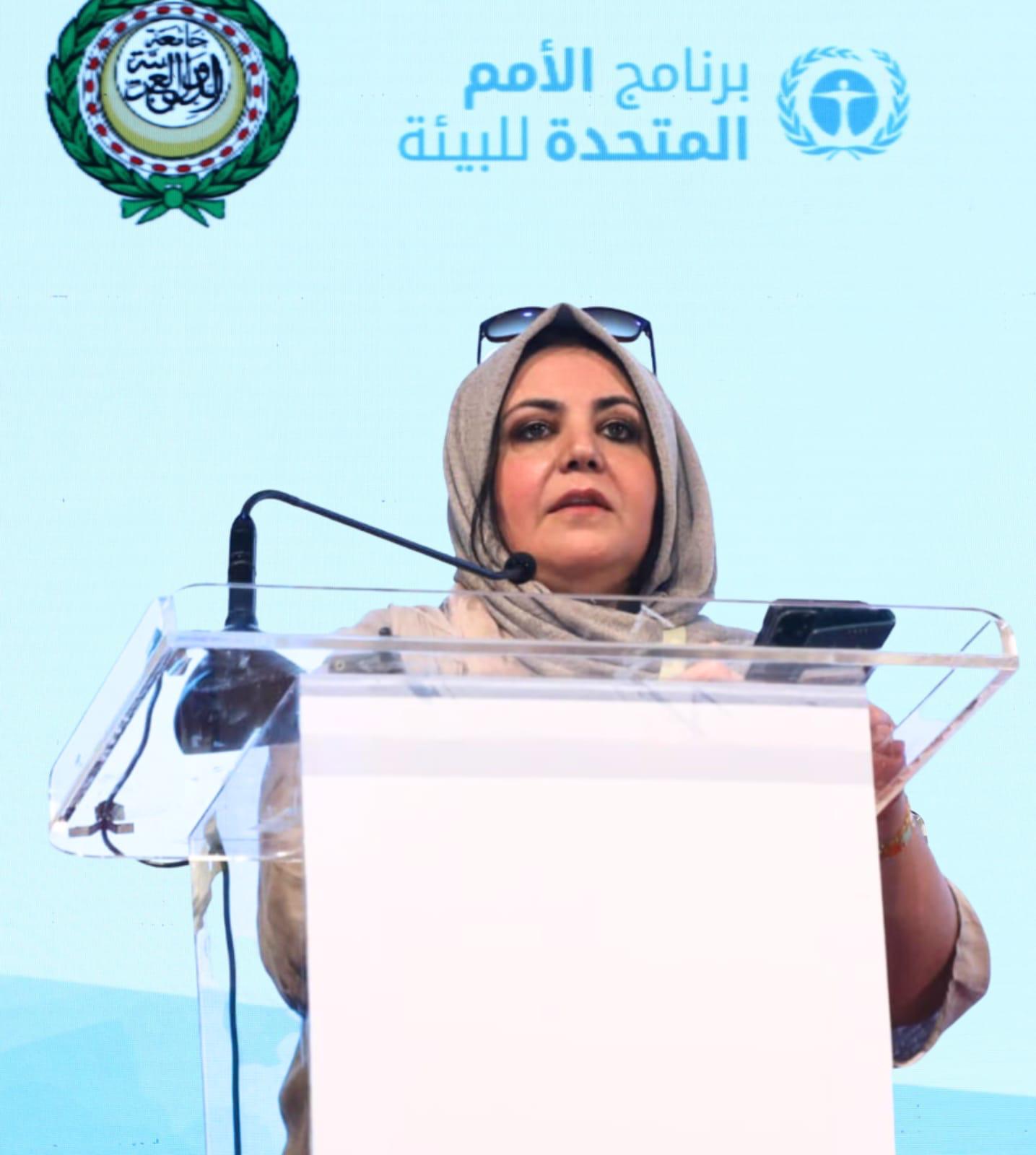
Dr. Wajdan Al-Aqab, President of the Kuwaiti Society for Environmental Protection and President of the Gulf Network of Environmental NGOs, in her capacity as the Regional Coordinator of the Facilitators Team for West Asia from the Core Group and stakeholders of the United Nations Environment Programme, presented the joint statement on behalf of the West Asia region in alliance with the Arab organizations accredited to the United Nations, at the second session of the Arab Forum for the Environment, organized by the Programme in cooperation with the League of Arab States in the Sultanate of Oman, to discuss issues related to food and water security in light of the climate crisis, within the thirty-fourth session of the Council of Arab Ministers Responsible for Environmental Affairs, at the 24th session of the Technical Committee for the Environment.
At the beginning of the joint statement, Dr. Wajdan Al-Aqab announced the solidarity of UN-accredited NGOs in West Asia with the Palestinian people and condemned the intensified Zionist aggression against the Gaza Strip. She commended the Arab League's emphasis on the importance of strengthening joint Arab action alongside the State of Palestine in its legitimate right to resist aggression and condemning Zionist crimes against people, land, water, and air, in order to uphold the principles of international humanitarian law, human rights, and the environment, based on shared values, interests, and a common destiny, and to conduct an international investigation into the environmental impact.
Al-Aqab reviewed the challenges facing accredited NGOs in West Asia regarding their engagement in regional and international spaces, and the need to focus efforts on increasing regional consultations and participation in preparing reports on the current and future situation in collaboration with stakeholders. The statement included three main themes discussed in the West Asia consultative meetings: climate change, biodiversity, and the issue of plastic pollution.
Regarding climate change, the statement called on the Arab Environment Forum to push for new and additional climate finance that is sufficient, flexible, predictable and available to local communities, especially those at the forefront of being affected by climate change, in a way that guarantees their right to resilience, recovery and the achievement of sustainable development goals.
Dr. Al-Aqab explained that the statement called on the Arab environment ministers in the member states to support and finance the participation of accredited civil society organizations in climate summits, and the necessity of adopting the establishment of the Loss and Damage Fund at the 28th Climate Summit, and fulfilling their commitments to double the funding of developing countries directed towards adaptation projects, and to compensate for damages in all economic, social and inter-regional sectors and support their adaptation in Arab countries that suffer from environmental disasters, wars, occupation, conflicts, sanctions, blockades, displacement and refuge, and to activate the role of social responsibility and involve the private sector and investment projects in the race towards zero and the race towards resilience, adding, ”The joint statement also called for the importance of involving member states in civil society organizations and building their capacities to contribute to the preparation of nationally determined contributions.“.
Al-Aqab stated, “With regard to the biodiversity framework, the statement urged the Arab Forum for the Environment to ensure its recommendations reflect the aspirations and priorities of the Arab region by reviewing national biodiversity strategies and action plans by the 16th Conference of the Parties, and the necessity of ratifying the Convention on Marine Biological Diversity under the United Nations Convention on the Law of the Sea, stressing the importance of conservation and preservation programs and restoring the efficiency of ecosystems in addressing the effects of climate change, improving resilience and combating desertification, and the importance of increasing funding for studies and research, assessing the baseline of biodiversity, focusing on endangered species, paying attention to the concept of nature-based solutions, and encouraging the application of the main biodiversity areas in West Asia.”.
Regarding environmental issues related to plastic pollution, Al-Aqab said, “The statement emphasized the role of governments in strategic planning to reduce the causes of plastic pollution through effective cooperation among all stakeholders and adopting the principle of transparency in presenting information and scientific facts to civil society institutions. It encouraged the adoption of national environmental laws and legislation related to the uses of plastic, to manage its manufacturing, use, import, handling of its waste and recycling. It also commended the trend towards investing in recycling plastic waste and encouraging the provision of waste collection and sorting centers in urban areas to reduce the percentage of municipal waste. We call on the Arab Forum for the Environment, the United Nations General Assembly and the leaders of the Arab Group to influence the importance of enabling the participation of Arab organizations accredited to the United Nations in the Intergovernmental Negotiating Committee on Plastic Pollution.”.
She added, “Despite the tireless efforts towards building a better future with sound and well-considered environmental practices regionally and internationally, and the recognition of international days with clear environmental goals internationally, such as the International Day for Disaster Risk Reduction, which falls on October 13, and the International Day for Preventing the Exploitation of the Environment in War and Armed Conflict, which falls on November 6, we unfortunately find that the map of the Arab world is the most distorted by these wars and conflicts, which has burdened the Arab environment with intractable problems that extend over generations and which inevitably require enormous efforts to recover and rehabilitate it.”.
Dr. Wajdan Al-Aqab pointed out that “deliberately considering the environment as a tool of war inevitably threatens water and food security, contributes to the spread of diseases, and disrupts efforts to combat climate change, environmental degradation, loss of biodiversity, and suffering from pollution on land, sea, and air. As for displacement, migration, and refuge resulting from these conflicts, we must emphasize that receiving and sheltering a large number of refugees in small Arab countries leads to serious repercussions in terms of social, economic, environmental, demographic, and pressure on natural resources.”.
The regional facilitator for West Asia, Dr. Wajdan Al-Aqab, called for “the inclusion in the final statement of the Arab Forum for the Environment of the solidarity of civil societies in West Asia with public and private institutions against the bombing in Gaza, lifting the siege and allowing food, medical and relief supplies, rejecting displacement, monitoring violations of human rights and the environment, agriculture and the environment, rehabilitating infrastructure and housing, and the necessity of unifying ranks, solidarity and cooperation in maintaining security and stability and striving to achieve more progress in Arab action, to emphasize the role of the League of Arab States in taking measures that would mitigate the risks of this disaster, appreciating their efforts in rescue and providing urgent assistance.”.
Dr. Wajdan Al-Aqab concluded, “In this context, we call upon the League of Arab States to commemorate the International Day for Preventing the Exploitation of the Environment in War and Armed Conflict annually to spread a culture of environmental protection and awareness, and to conduct an assessment of the environmental impact of these wars on the Arab map. We are pleased to remind the Arab community that civil society organizations have leading roles in this vital field. For example, November 6th, with its international goals and endeavors, is the result of a demand made by a long-established Arab association, the Kuwaiti Society for Environmental Protection, in 2001. Herein lies the importance of supporting civil society organizations.” Regarding the implementation of the Arab Environment Forum’s ambitions, she said, “We realize that the final statements of the Arab Environment Forum do not come out of thin air, and their alignment with the demands of UNEP-accredited non-governmental civil society organizations is appreciated by everyone. However, they require enabling means for implementation at all levels by providing a platform for establishing a regional dialogue between stakeholders to exchange information and experiences in relevant environmental sectors.” She called for “developing a mechanism that enables organizations to engage in long-term, results-oriented cooperation between non-governmental organizations and Arab ministers of environment, finance, and economic planning to support local communities in implementing their development programs and achieving the Sustainable Development Goals.”.
Dr. Al-Aqab added, “We hope that Arab environment ministers will encourage organizations to join regional and sub-regional environmental networks and alliances, as these provide serious platforms for exchanging experiences. We also aspire for organizations accredited by the United Nations Environment Programme to join the League of Arab States.” She continued, “We reiterate our demand for the inclusion of associations in all periodic regional meetings and in all existing and future United Nations environmental agreements to strengthen their oversight role in monitoring their implementation on the ground. We reaffirm, as Arab civil society organizations, our full commitment to working with you all in the process of finding and implementing solutions to every problem so that no one is left behind.”.