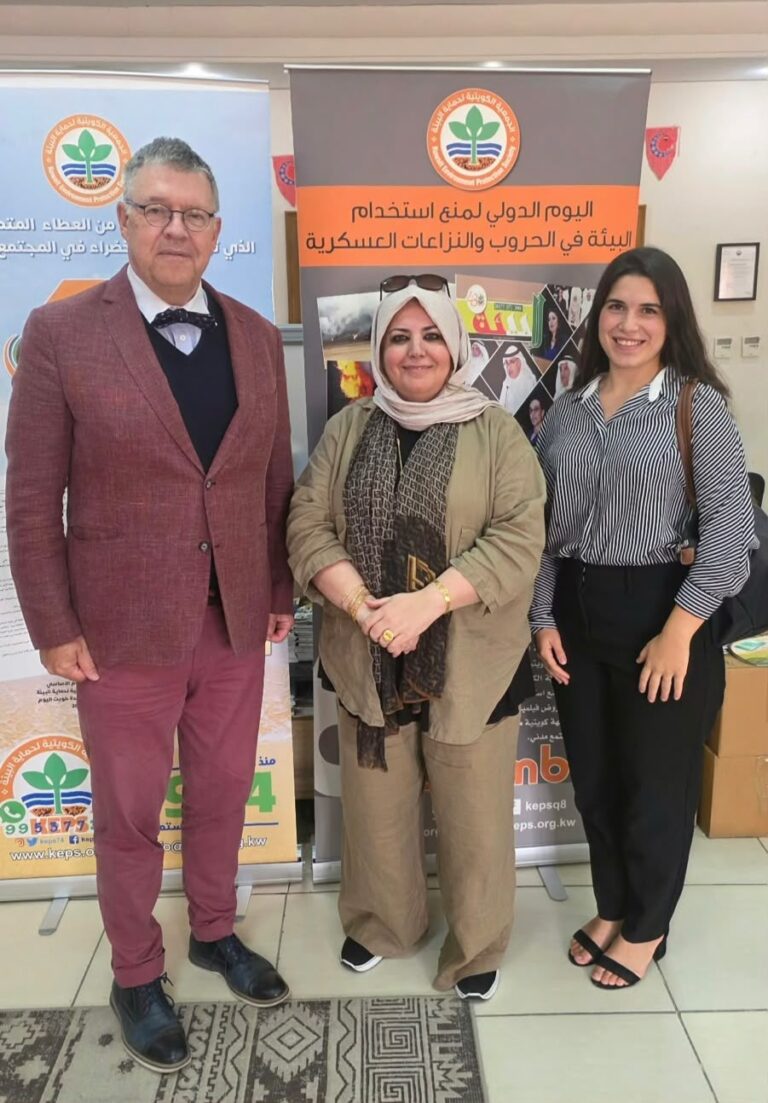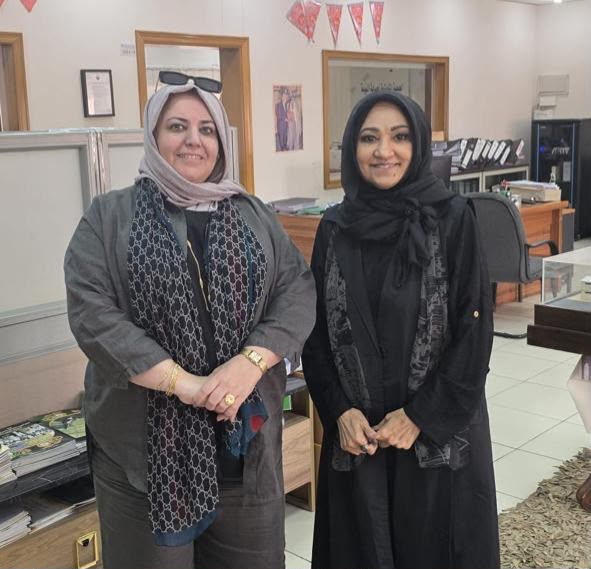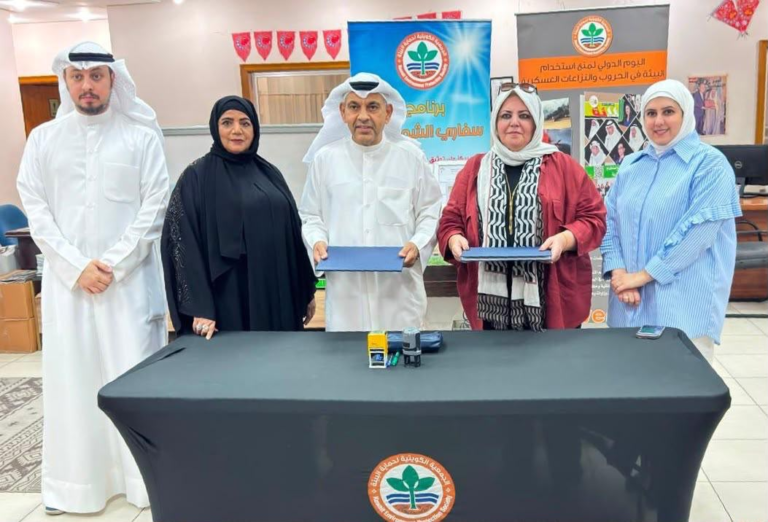
In support of student environmental projects and initiatives implemented by students within the school campus, and within the framework of the Green Schools Program, and to encourage student activities of an environmental nature, the President of the Kuwait Environment Protection Society, Dr. Wijdan Aloqab, visited Saleh Shehab High School, where she was received by the school’s principal, Mr. Muhammad Abbas.
“The tour, organized by the school administration, showcased the efforts of the greening team in improving the learning environment by increasing green spaces and utilizing available areas to create sites for agricultural experiments and organic waste recycling, thus contributing to enhancing sustainability within the school. In addition, it highlighted the initiatives of the art department in recycling and transforming waste into educational tools and art pieces used and displayed within the school, thereby promoting a culture of circular economy among students.”.
This came in a press statement by the head of the Environmental Protection Association, Dr. Wijdan Aloqab, who praised the idea of the outdoor classroom in the school garden, considering it “a qualitative step to improve the educational environment and develop its outputs in an attractive and interactive way, linking theoretical learning with practical experience in the open air, which is an approach emphasized by modern educational experiences in environmental education.”.
Dr. Aloqab, who appreciated the constructive cooperation between the school administration and parents, and the benefit of their capabilities and experiences for the benefit of the learners, stressed that “this model of social responsibility is reflected positively on the level of academic achievement and enhances the spirit of initiative and teamwork among the students,” adding, “The project to establish the greening team in cooperation with the Special Forces Environmental Action Team comes as a practical translation of this cooperation through the efforts of Warrant Officer Ahmed Al-Nasser as a parent, and as an encouragement for learners to engage in environmental activities.”.
She stated that during the tour, she “learned about the mechanism for caring for diverse agriculture within the school walls in cooperation with the biology department, as the school includes four independent gardens, each with different goals and identity, including a garden for agricultural experiments, a garden for producing leafy greens, a garden for the outdoor classroom, and others.” In this context, she suggested “taking advantage of the diversity of these gardens to launch the school environmental record as the team’s first project, to measure temperatures in different parts of the school, which highlights the importance of citizen science in scientific studies, and gives students practical experience in research planning, data collection, and understanding variables and their impact on results. This can also be applied to compare temperatures in locations where plant types and shade areas differ, to highlight the impact of greening and expanding green spaces on the local microclimate.”.
She pointed out that “such experiments can be led efficiently by the Biology Department and can be directly employed in explaining the topics of the scientific curriculum, linking education to practice and enhancing scientific thinking among students,” praising “the positive outcomes of these initiatives that encouraged students to continue their environmental activities even outside of official school hours, and their participation extended to external activities, including the team’s first trip to the Al-Shamiya Reserve to attend the seed exchange event,” as well as “the efforts of the greening team in improving the school environment by increasing the green space, and utilizing available spaces to create sites for agricultural experiments and recycling organic waste, which contributes to promoting sustainability within the school.”.