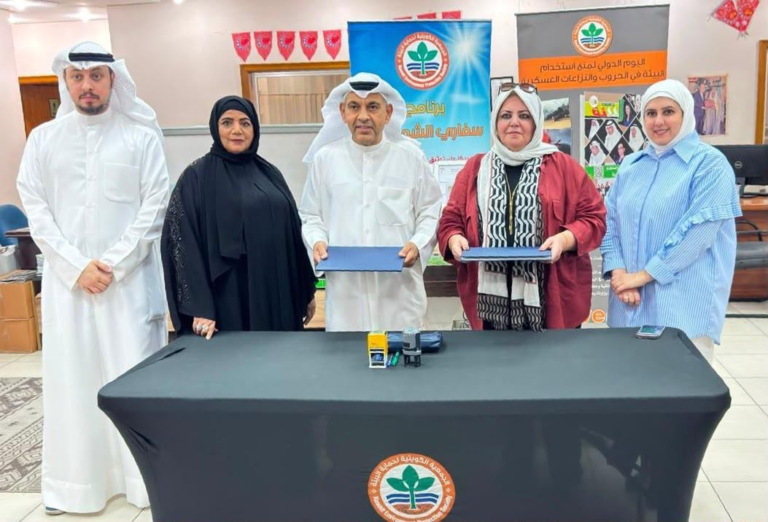
The Kuwait Environment Protection Society confirmed that the «Beach Safari» program, which it organizes in cooperation with Rasameel Investment Company, provides school and university students and volunteer groups with a knowledge summary and guidance on beaches, their environments, natural habitats, rocky components, types of beaches, in addition to the tidal zone and its living organisms.
Coasts and beaches
Nawaf Al-Muwaile, a member of the association's board of directors, explained that the program focuses on coasts, beaches, their environments, natural components, and living organisms, and calls for the importance of preserving them from all types of pollution, including plastic waste.
The world is interested in celebrating the oceans. Al-Muwail explained that the Beach Safari program, which includes many aspects such as field visits to various beaches, coastal areas, and tidal zones, and highlights the most prominent violations and damages to any of them, in an educational, awareness-raising, and guidance manner, and in light of what the association has observed in terms of large quantities of plastic waste in different environments and the dense spread of plastic waste on the coasts and beaches, was keen to include in its activities a series of theoretical and field scientific lectures and practical workshops that address the topic of plastic waste and its negative effects on the coastal environment, its components, and living organisms. These lectures and workshops are presented to male and female students, civil society organizations, and private companies concerned with the field of environment, coasts, and beaches.
Lectures and workshops
He added that the series of lectures and workshops aligns with the Kuwait Environment Protection Society's "Kuwait Bay: Life" initiative, which it launched earlier to coincide with World Oceans Day celebrations, noting that the invitation to participate in
The program is open to schools, universities, volunteer groups and interested private companies through registration via the association’s website.
plastic pollution
Nawaf Al-Muwaile stated, "The impact of plastic pollution through ingestion and entanglement among marine animals, ranging from zooplankton to whales, seabirds, and marine reptiles, affects the absorption of persistent organic pollutants."
Plastic is then transferred to tissues and organs through ingestion, affecting large marine organisms as well as organisms at lower levels of the food chain. Al-Muwaile added, »The first reports of plastic waste in the oceans were in the early 1970s, which drew the world’s attention to this floating danger. The entire global fishing fleet now uses plastic gear, some of which is lost or even carelessly discarded at sea during use. Kuwait suffers from the problem of debris and «ghost fishing» using abandoned gear left behind by fishermen.»
Scientific content
A member of the Environmental Society's board of directors stated that the scientific and practical content of the upcoming Beach Safari program will provide participants with scientific facts and information resulting from the latest research and field studies. He added that the most prominent findings include: "Plastic pollution worldwide is distributed throughout all oceans due to its buoyancy and durability. The absorption of toxic substances by plastic during its journey through the environment has led to plastic particles being transported through photolysis and other weathering processes. Plastic fragments and spread throughout the ocean. The primary sources of plastic production are enclosed bays, seas surrounded by coastlines, and densely populated bodies of water." According to a study published by Marcus
Ericsson in 2014 said that plastic pollution in the world's oceans meant that more than 5 trillion pieces of plastic weighing more than 250,000 tons were floating in the sea.»