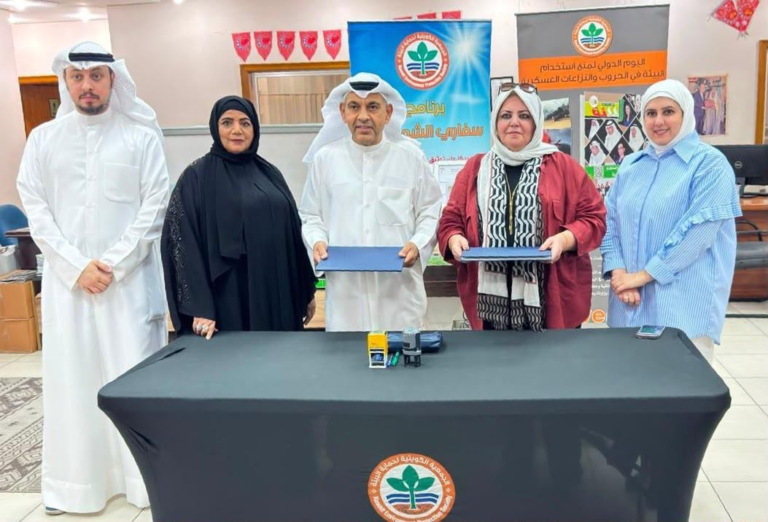
The Kuwait Environment Protection Society announced the results of its periodic online survey, which was conducted with a representative sample of 351 participants from the six governorates, covering 12 topics related to the fate of solid household waste in […]
Nawaf Al-Muwail, a member of the association and coordinator of the opinion poll and awareness measurement campaign, said, “351 participants from all governorates of the State of Kuwait contributed to the survey study in varying proportions, with the highest participation coming from Al-Farwaniyah Governorate, followed by the Capital Governorate. The study examined the number of family members in the home, and the highest percentage (56.1%) was for families with 4-7 members, while families with more than 12 members living in the home had the lowest percentage (7.1%). Of the Kuwaitis studied, 90% held university degrees (67.8%), diplomas (26.2%), and high school diplomas or less (6%).”.
Al-Muwail added, “The fate of household solid waste in Kuwait is three landfills: Al-Jahra, the Seventh Ring Road (Southern Road), and Mina Abdullah. When asked, “Do you know the fate of waste in Kuwait?” 40.21 TP3T of participants answered that there are designated landfills, while the remaining 26.21 TP3T did not know where the waste goes.” He pointed out that “22.51 TP3T believe that the waste is burned in designated areas, which is the worst belief, while 8.41 TP3T believe it is buried in the desert, and the small remainder do not care to know the final destination of household waste.” He explained that the survey confirmed that “the Coronavirus crisis affected food consumption and waste production, especially during the total and partial lockdowns. During this time, restaurant services and daily meal subscriptions, which produce large quantities of plastic, cardboard, and paper waste, were suspended. In addition, visits to cooperative societies were restricted to non-essential items through a pre-booking system, which inevitably had an impact on purchasing quantities, either positively or negatively. Who among us did not witness the excessive purchasing at the beginning of the crisis?” The Ministry of Information has a role in raising positive awareness regarding purchase quantities and reassuring citizens and residents about the availability of food commodities.”.
In asking the study group about the impact of the Corona crisis on food consumption and waste production, he said that “57.5% of them confirmed that daily consumption was affected and increased significantly, and with it the amount of waste produced from the home increased, while 13.7% neither their consumption nor their waste production was affected, and 20.2% of them did not notice the change, and 8.5% reduced waste by reducing consumption, and that “62.1% of the participants noticed the amounts of excess and wasted food from their daily meals, and 26.8% notice it sometimes, which is a good percentage and indicates a very good awareness among citizens and residents of the responsibility towards the blessing and its preservation, while 9.4% do not notice it, and the smallest percentage does not care.”.
The campaign coordinator and member of the Environmental Society stated, “The survey results showed that only 9.4% of participants dispose of leftover food and surplus food by throwing it in the trash, while 42.7% take it to refrigerators designated for surplus food, which some benefactors place near their homes in residential areas, and which are used by those in need or passersby. 45.3% of participants keep the food and eat it later, and the remaining 2.9%, the smallest percentage, do not pay attention to the details.” He emphasized that “306 participants from the survey group support the idea of recycling paper, plastic, and leftover food, and designating a day of the week for collecting it like other household waste.”.
Nawaf Al-Muwaile emphasized that “the monitoring team identified three general problems related to waste disposal in Kuwait: littering in undesignated areas, excessive waste production per household, and the lack of designated recycling areas. 631,000 participants confirmed that all of these are existing problems, while 141,000 believed that the most significant issue is the lack of designated areas for recyclable waste such as paper, plastic, glass, aluminum, and others. Littering in undesignated areas was identified as a problem by 17,710 participants.” He added, “It is regrettable that the environmental law will be over five years old, yet a large number of people are still unaware of the violation of littering in undesignated areas. 581,000 participants are a considerable number, and 8,510,000 believe that littering is not a violation, while the remaining few are simply indifferent to these details.” Furthermore, “in a study on plastic consumption behavior, 711,000 participants indicated that they reduce their use of plastic bags after purchasing daily necessities from cooperative societies, a percentage that reflects awareness.” The high percentage of participants emphasized the importance of reducing waste production, especially bags, while 19.4% did not pay attention to this observation, and the rest, at a rate of 8.8%, did not care.
Al-Muwail concluded, “The participants left a set of valuable observations that included creative solutions and valuable suggestions, including encouraging those who recycle with monetary rewards or points added to the shareholders” fund in cooperative societies through collection points in cooperative societies. Many participants stressed the importance of starting a recycling project and including different containers in the household waste collection program, and replacing plastic bags with other biodegradable or environmentally friendly plant-based bags. One participant mentioned the need for periodic cleaning of areas with the help of the residents of the area so that it would be a program in which the citizen and resident feels the importance of cleanliness in the residential area and learns about solutions to environmental problems around him, and activating immediate fines and increasing advertising campaigns and other means of awareness in different languages such as English, Hindi and Filipino.”.