The Kuwaiti Society for Environmental Protection concluded its specialized environmental training program, which it organized virtually at its Sabah Al-Ahmad Environmental Training Center, by announcing the graduation of 470 trainees who joined in groups in 9 training courses presented by 10 Kuwaiti and Arab experts over a period of about 40 days.
The Secretary-General of the Association, Jinan Behzad, said that the ten trainers presented specialized courses in environmental sciences in its various fields, marine sciences, desert sciences, climate change, environmental management, environmental journalism, visual environmental media, sustainable development and environmental policies, noting that the number of trainees registered and benefiting online in the courses reached 470 participants in the total number of courses presented by the experts in a number of hours amounting to about 515 training hours, stressing that the nine courses witnessed participation from 21 Arab and foreign countries, namely “Algeria, Canada, Egypt, Italy, Jordan, Lebanon, Palestine, Morocco, Saudi Arabia, Sudan, Syria, Yemen, Turkey, the Emirates, Bahrain, Iraq, Oman, Qatar, Libya and Mauritania, in addition to trainees and participants from the State of Kuwait.”.
Behzad explained that “the nine sessions produced several practical recommendations with a strategic approach, including a proposal to establish an Arab organization for young environmentalists, to be headquartered in Kuwait, given that the Environment Society was the proposer of the proposal. Other recommendations included localizing and digitizing environmental solutions, incorporating environmental education and focusing on environmental concepts tailored to each age group within school and university curricula in all Arab countries, addressing climate change and adopting adaptation plans in a radical manner, providing innovative solutions to confront climate challenges in the Arab world, implementing environmental protection laws, international laws and treaties, and raising awareness of their importance, as well as accelerating the implementation of the Sustainable Development Goals, encouraging young people to choose environmental specializations, and transitioning to a green economy by transforming projects and creating alternative opportunities to traditional work. Finally, the recommendations included the Kuwaiti Society for Environmental Protection organizing an annual Arab forum for young environmentalists.”
The Secretary-General of the Environment Society announced the launch of the Society’s “Ramadan Environmental Cultural Season starting from the first week of the holy month. It consists of focused groups of international workshops, each lasting one day, in which Kuwaiti, Arab and international experts will participate to find solutions to environmental problems in the Arab world, which have been identified in the Social Responsibility Document.” She emphasized that “the season will consist of practical workshops to find joint solutions that can be implemented through cooperation with official channels through the Society’s membership in the Arab Network for Environment and Development (RAED) and its presidency of the Gulf Network of NGOs for Environmental Societies, as well as the General Secretariat for Environment and Sustainable Development at the League of Arab States, with a focus on emerging environmental issues such as achieving the Sustainable Development Goals in the environment and plans and policies for adapting to climate change.“.
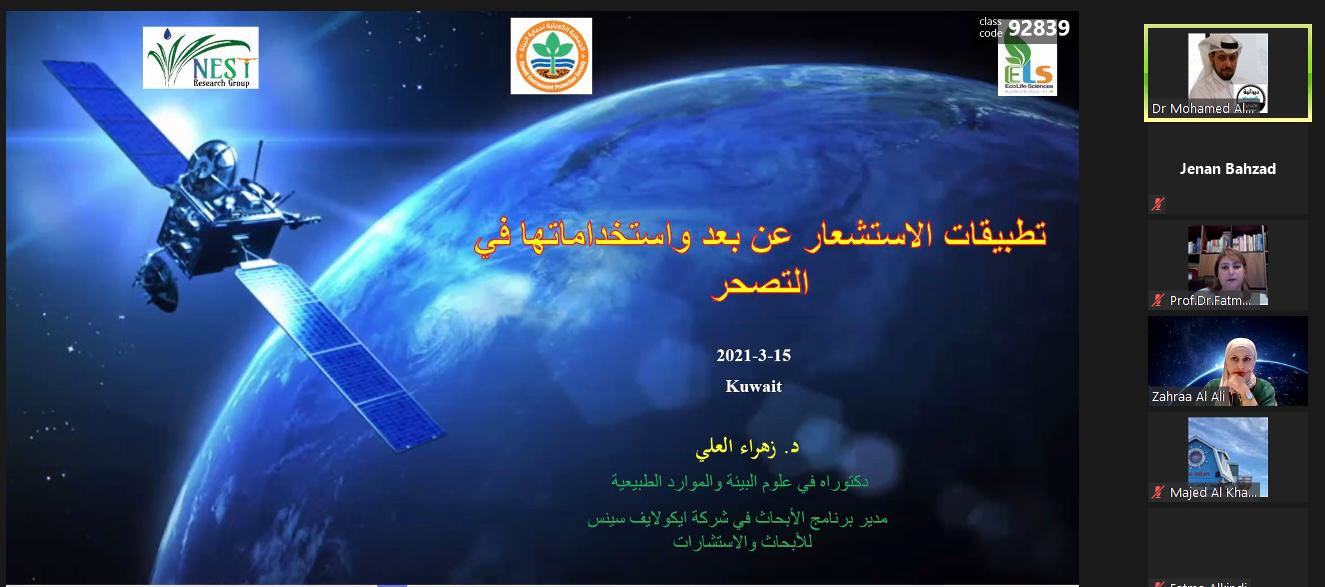
In a related context, Dr. Zahraa Al-Ali, Research Program Manager at Ecolife Science Environmental Consulting, delivered a presentation on remote sensing and unconventional methods for gathering information for scientific research on the final day of the specialized training program. She stated, “The first part of the workshop provided a general introduction to remote sensing, which is considered an unconventional method for gathering information about the Earth's surface without direct contact, whether it be vegetation, soil, or even water bodies. Images are captured by sensors that are either mounted on satellites, aircraft, or drones, relying on electromagnetic radiation emitted from the Earth's surface. This technology is of great importance, especially in monitoring issues related to land degradation. It is superior to traditional methods in that it saves time and effort, and it reflects the state of the land periodically with its geographical coordinates. This makes it easier to identify any environmental disturbances in their early stages, thus facilitating their intervention.”.
Dr. Zahraa Al-Ali explained: “In the second part of the workshop, we learned about the contribution of the NIST Scientific Research Group in publishing research using remote sensing technology. Founded in 2017 by Dr. Meshal Abdullah, a faculty member at the University of Texas, the group includes a number of Kuwaiti and international researchers from various universities who collaborate to acquire and exchange expertise. The research group focuses on the interplay between the components of the desert environment and the impact of climate change on them. Numerous studies have been published on understanding desert plants, the services they provide to the environment, and the factors affecting them, all using modern technologies.”.