The Kuwait Environment Protection Society stated that during the Corona pandemic and the continued closure of schools since February 2020, its environmental awareness program “Green Schools” is working in parallel with the program’s strategic plans, adapting to electronic work to meet the needs of students and teachers in public and private sector schools for developments in environmental sciences and to acquire environmental values and behaviors, especially at a time when talking about the security and safety of human health and the environment has become a priority for every citizen.
The society announced, “At the conclusion of the tenth training season of the Green Schools program, which was exceptional this year due to the Corona pandemic, which made all school and university students in the world learn from home, despite more than a year having passed since the spread of the COVID-19 pandemic, nearly half of the world’s students are still affected by the partial or total closure of schools, and more than 100 million additional children will fall below the minimum level of proficiency in reading as a result of the health crisis, according to initial estimates by UNESCO. Prioritizing the restoration of education is crucial to avoid a generational catastrophe.”.
The Secretary-General of the Society, Jenan Behzad, said, “In continuation of our role in awareness and education, the “Green Schools” program was published in its electronic version for the second year in a row, through which it measures the awareness of the student and teacher regarding local environmental issues based on the Kuwait Environment Protection Society’s educational curricula, which are presented in a simple and appealing way for the recipient, making the scientific material easily accessible to all age groups.” She added, “The target group was students, which was the largest group of participants in the electronic program, with student participation exceeding approximately 701,000,000 from the target group, while the rest of the participation from non-student age groups in different educational stages and the university stage was considered as an awareness-raising activity.”.
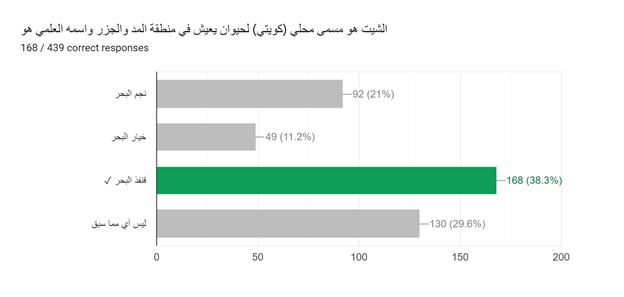
Behzad announced the results of the survey with which the society concluded its tenth season of the Green Schools program, and said: “The program included 10 topics distributed across general culture and information from the local environment. The participants passed the tests with varying scores, and the most neglected questions by the participants were about climate change, followed by the question about the local name for the animal (the tidal eel) that lives in the intertidal zone.” She pointed out: “In the first question that was presented to the participants, it was about the slugfish in the Kuwaiti marine environment (and the question about the habitat of this fish), and the correct answer was 60%, which is a bottom-dwelling fish. An episode of the environmental awareness program “A Fish Every Day” was shown to the participants to learn about the characteristics of other fish, such as their species, diet, body morphology, and its effect on their adaptation to the bottom-dwelling environment.”.
She added: “The second question was also about the marine environment and was in the Kuwaiti dialect. This question was the second most neglected and was skipped because the answer was unknown. The sea urchin, known as 'sheet,' is a familiar shape, distinguished by its black color and spines. There are many types of sea urchins, and they live in the intertidal zone. When they die, they leave behind their spiny, spherical shell, which we sometimes see on the beach when carried by the waves, or we see the remains of their black spines among the grains of sand after they break into small pieces. As for the question that was left unanswered more than 188 times, it was about the phenomena resulting from climate change, namely (increased temperatures, dust, rising sea levels, and fires). It was chosen correctly only 191 times, representing 43%.“ She emphasized that ”the Kuwait Environment Protection Society’s interest in raising awareness about the effects of climate change through the Society’s various programs and activities continues under the Climate Change Literacy Campaign, and it hopes that it will have a place in education at different educational levels because it is considered a global issue in the coming years.”.
The Secretary-General of the Environment Society stated that in the question about birds living in the Kuwaiti environment, the participant was given the choice between a group of birds that live in the Kuwaiti environment, and the most popular choice was 55% for the correct answer, which was (the turtle dove, the shepherd's nest, the sandgrouse, the stilt-tailed dove). She added: “In a simple question, which was true or false, about whether there are valleys in Kuwait, the participants were almost evenly split between true and false, with 52% answering in the affirmative and the rest in the negative. The correct answer is that there are definitely valleys in Kuwait, and they are numerous, some of which are well-known and some of which have not received enough local recognition. One of the famous valleys is Wadi Al-Batin, which was presented in the educational program through an introductory video filmed from the program “Every Day a Picnic” in the southern triangle region of the State of Kuwait, where the borders of the Kingdom of Saudi Arabia, the Republic of Iraq, and the State of Kuwait meet. The main course of Wadi Al-Batin appears, which was a flowing river in the rainy eras, but after the climate conditions changed and drought prevailed, it became a dry valley that flows only once every few years.”.
Behzad stated: “In the question about the largest nature reserves in the State of Kuwait, the majority of the answer was wrong. The Sheikh Sabah Al-Ahmad Reserve, which has two parts, land and sea, is not the largest reserve in Kuwait. Rather, Mubarak Al-Kabeer Marine Reserve is the largest nature reserve in the State of Kuwait. It is located in the north of Bubiyan Island and includes Warbah Island. It covers an area of 515 square kilometers and was declared a nature reserve in 2011.”.
The Secretary-General of the Environmental Protection Society explained, “The offense of littering under the Kuwaiti Environmental Protection Law received 71% correct answers, and the penalty is a fine of no less than 50 dinars and no more than 500 dinars. Promoting the development of green communities is incomplete without full awareness of the law and its application. All future technologies contribute to raising environmental awareness among consumers, and it is very easy to adapt society in a rapidly changing world that, through technology, necessitates conserving electricity, finding alternative fuels, and developing environmentally friendly products.” She pointed out that ”the official environmental portal of the State of Kuwait contains scientific information about the Kuwaiti environment for all segments of society, and it is called ”Our Environment.’ 67% answered this question. The ‘Our Environment’ website is available to every learner to obtain accurate environmental information, and students can access the data required for scientific research and specialized studies in various fields of science related to the Earth, the environment, and wildlife.”.
Janan Behzad explained that “the national flower of the State of Kuwait is the Arfaj, while more than 155 people chose the Nuwair flower, and the “Every Day a Plant” program has a great impact on education, as the production of the Environmental Media Center at the Society over 7 years is considered a scientific visual record of the Kuwaiti environment containing no less than 190 video episodes to document the natural and wildlife life in the State of Kuwait,” adding, “Returning to local names and marine life, the ”Awaw is a living creature that lives in the Kuwaiti environment, its local name is ‘Awaw and its scientific name is the sea star, and it is one of the echinoderms that adults and children enjoy when they find it on the coasts.”.
Behzad concluded: “As for the Sustainable Development Goals related to the environment, the answers were numerous. There is no doubt that all the goals, when fully and properly achieved, affect the health and quality of the environment. However, linking the goals and achieving them does not happen without instilling environmental citizenship in society, which is the relationship between the citizen and the components of the environment in which he lives. This is done by including the natural environment in daily environmental behavior in a way that enhances the health of the environment and protects it, and by strengthening the role of laws and legislation on which the citizen relies to know his rights and duties, and giving priority to environmental issues within sustainable development plans.”.