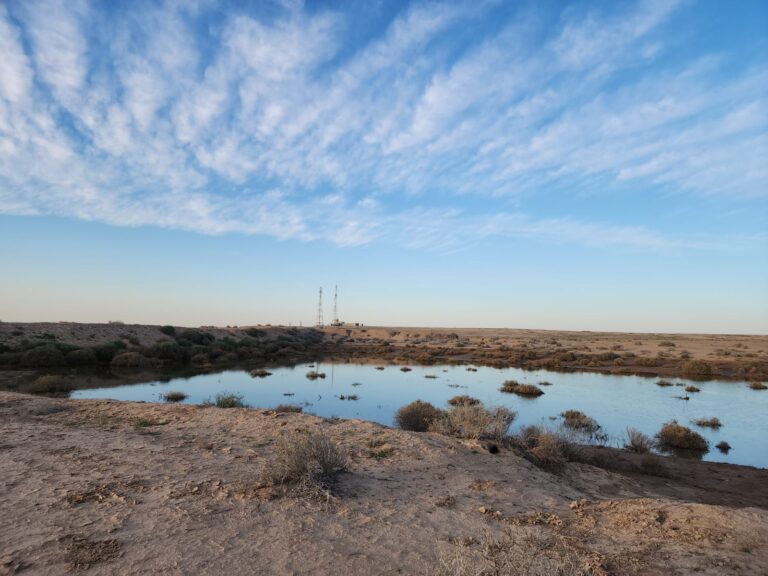
In conjunction with the heavy rainfall that the State of Kuwait has recently experienced, the Kuwait Environment Protection Society, through its Chairman of the Board, Dr. Wajdan Al-Aqab, called for “avoiding playing and tampering with water pools because they contain pathogenic germs from sewage and chemicals from fertilizers in public gardens, a situation described during floods and torrents as “filthy soup” because it contains many biological, chemical and other pollutants due to its passage through different locations that allow the mixing of what passes through its path.”.
In this regard, Dr. Al-Aqab emphasized that the association had previously announced its vision for a comprehensive national plan to address floods and rainfall. She added that the association has frequently called for the establishment of a national body to manage the risks of natural disasters, including flash floods, comprising experts and academics from relevant government agencies and civil society organizations. She noted that the association is working diligently on awareness and educational programs for all segments of Kuwaiti society during environmental crises.
She added: “The association believes that the best system for managing floods in the State of Kuwait consists of three axes: (safe avoidance, flood response, and mitigation of flood risks). The first axis includes safe avoidance of floods to protect lives and property by staying away from flood paths as much as possible.“ She continued: ”Safe avoidance of floods, which falls under the sustainable use of land, means not establishing facilities, residences, roads, or other things in the natural paths of floods in order to protect lives and facilities.”.
The head of the Environmental Association stated, “In cases where it is necessary to establish vital facilities in natural flood paths for security reasons (for example), special measures are taken to design and implement a flood prevention plan that includes dams, underground reservoirs, and smart drainage systems, as well as defining appropriate building codes for the buildings and roads that will be constructed in flood paths.” Regarding the second aspect of flood mitigation, she explained that it “is achieved through the design and implementation of an integrated prevention plan that includes engineering systems for check dams, storage systems, and drainage regulators, in addition to flood monitoring and surveillance systems based on hydrological, geomorphological, and climatological studies.”.
Dr. Al-Aqab explained that “the third axis is the mitigation of flood risks, which includes measures related to the design and operation of early flood warning systems (warning signals at least 12 hours before floods occur), and the preparation and training on emergency plans. In addition to implementing an effective early warning system, this allows for the implementation of numerous measures that reduce losses of life and property, especially since Article 118 of the Environmental Protection Law No. 42 of 2014, as amended by Law No. 99 of 2015, supports this axis.”.
For his part, Dr. Raafat Misak, a member of the Wildlife Protection Committee of the Society and Executive Director of the Kuwaiti Vision Company for Environmental Projects Management, affirms that the indicators of success of flood risk mitigation plans include “following the philosophy and vision of the Sendai Framework for Disaster Risk Reduction (2015-2030), investing in flood prevention systems, water harvesting technologies, and recharging groundwater reservoirs near the surface (recharge wells), and making optimal use of water, taking into account that it is a precious natural resource and not investing in it is a great loss, and the importance of relying on advanced systems to preserve the soil and reduce its erosion, along with the vegetation cover that grows on it.”.
Dr. Misak points out that “the implications of unsustainable management of flash floods include loss of life, destruction of infrastructure, paralysis and disruption of human interests, as well as the waste of rainwater (failure to invest in a precious natural resource), as happened in many locations, including the eastern part of Sabah Al-Ahmad residential city, the Wafra-Mina Abdullah road, the Burgan oil field, and the southern coast, and the erosion of large quantities of soil, which is classified as a non-renewable resource.”.
The Environment Society, through Dr. Raafat Misak, presents the unique “Al-Ahmadi Ridge – Al-Ahmadi Valley – Al-Ahmadi Floods” system, stating: “The issue of flash floods in Kuwait cannot be addressed without discussing the Al-Ahmadi Ridge – Al-Ahmadi Valley – Al-Ahmadi Floods system.” He explains that “Al-Ahmadi Ridge is a rainwater collection unit in Kuwait, and it is the only one located near residential areas in the country. It extends north-south along the Arabian Gulf coast for approximately 8 km westward, from Al-Dhaher in the north to Al-Ahmadi City in the south. Al-Ahmadi Ridge is approximately 120 meters above sea level, is about 35 km long, and has an average width of 5 km. A watershed divides the crest of Al-Ahmadi Ridge.”.
He points out that “two surface drainage systems are formed on its sides, the first being the eastern valley system and the second being the western valleys and the Khubari. The eastern valleys flow into the Arabian Gulf and cut through the middle of residential areas, including Al-Manqaf, Al-Sabahiyah, Al-Fahaheel and South Al-Sabahiyah. The eastern valleys of the Ahmadi Ridge are among the active valleys, as their waters flood the roads and tunnels and carry with them thousands of tons of soil in the form of mud and silt, which causes obstruction of movement on many roads, including the Al-Fahaheel road.”.
Dr. Raafat Misak, a member of the Environment Society, concluded, “The floods in the eastern valleys caused serious damage to facilities, as happened between November 3 and 25, 2018. On the other hand, the ongoing floods in the western valleys of the Ahmadi region caused the destruction of the Burgan oil field’s road network and the flooding of areas of the field, which resulted in the cessation of activities and disruption of production for periods of time.”.