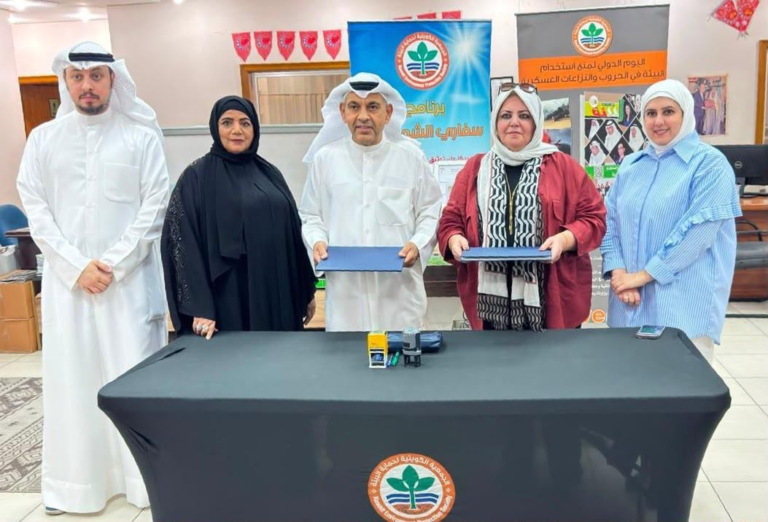
The Kuwait Environment Protection Society, represented by the Sabah Al-Ahmad Center for Environmental Training, in cooperation with the International University, organized a workshop on the occasion of the World Day to Combat Desertification and Drought. The workshop included a series of scientific lectures and research presentations delivered by a select group of academics and specialists, with the aim of highlighting the dangers of desertification in Kuwait and the region, and proposing innovative scientific solutions to mitigate its effects.
Desertification is a global challenge affecting the lives of one billion people in more than 110 countries, including the Gulf Arab states. According to estimates by the United Nations Environment Programme, the costs of preventing desertification are five times less than the losses resulting from ignoring it, highlighting the importance of early intervention and sound environmental planning.
In this regard, Dr. Ahmed Al-Qasabi, Associate Professor of Geomorphology and Geomatics and a member of the Society, gave a lecture on the impact of climate change on the increase in flash floods in Kuwait, explaining the results of a recent study that used remote sensing and modeling techniques to identify danger zones, and proposing 22 sites for rainwater harvesting, which would reduce soil erosion and degradation.
For her part, Dr. Wafaa Behbehani, a member of the association, emphasized in her lecture, “The Role of Nature Reserves in Combating Desertification and Preserving Biodiversity,” that nature reserves are among the most prominent tools for combating desertification, given their role in protecting vegetation and soil, supporting scientific research and education, and achieving sustainable environmental development. She also highlighted the Sabah Al-Ahmad Nature Reserve as a prominent national model, noting its rich biodiversity, including desert plants, migratory birds, mammals, and reptiles.
The lecture concluded by emphasizing that the success of efforts to combat desertification requires the activation of international environmental agreements, the promotion of community awareness, the expansion of the establishment of reserves, and sustainable afforestation, with the need to strengthen community partnership to protect these areas and ensure a safe environment for future generations.
In the same vein, Ahmed Murad, a member of the Kuwait Environment Protection Society, stated that desertification in Kuwait is a pressing environmental issue caused by a combination of climatic factors and accumulated human activities. He explained that among the most prominent reasons for the exacerbation of desertification in the country are low rainfall and high temperatures, in addition to soil degradation and erosion due to overgrazing, which leads to the loss of vegetation cover. He also pointed out that sand encroachment resulting from strong winds and the absence of effective natural barriers have contributed to the degradation of vast areas of land. Furthermore, the weakness of sustainable greening and afforestation programs has accelerated the pace of environmental degradation, necessitating a joint intervention that combines scientific solutions with integrated environmental planning.
At the conclusion of the workshop, a number of recommendations were summarized for combating desertification in Kuwait. These recommendations emphasized the need to adopt innovative and sustainable solutions that address the root causes of the problem and mitigate its environmental and economic impacts. The recommendations included expanding the establishment of nature reserves to protect vegetation and soil, and enhancing afforestation programs using drought-resistant native plants. Participants also stressed the importance of rehabilitating degraded lands and utilizing treated wastewater in urban greening projects. The workshop recommended regulating grazing, monitoring human activities in environmentally sensitive areas, and enforcing national environmental legislation. Furthermore, the importance of raising environmental awareness and promoting environmental education was underscored, along with encouraging scientific research and employing modern technologies such as remote sensing to monitor degraded areas and develop precise and effective restoration plans.