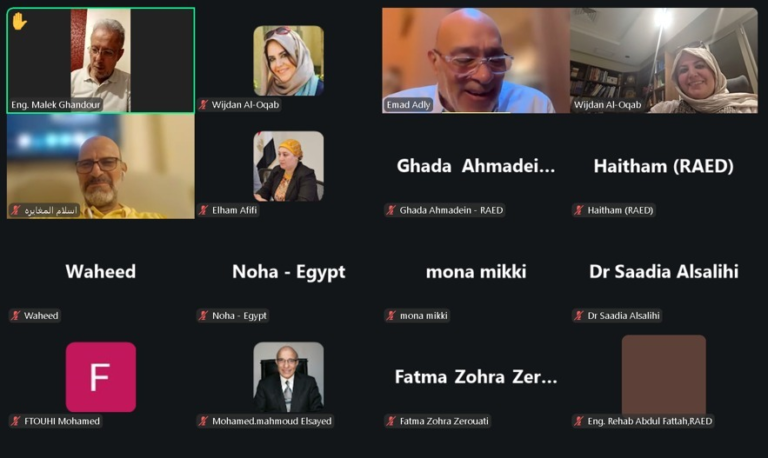
The virtual “Experts Workshop” organized by the Sabah Al-Ahmad Center for Environmental Training at the Kuwait Environment Protection Society recommended preparing a document of solutions to reform environmental education and including educational curricula to evaluate environmental behavior, through a package of recommendations concluded by the environmental educational experts participating in the workshop.
Mr. Abdul-Amir Al-Jazaf, Vice President of the Environment Society, confirmed that “the second expert workshop organized by the Sabah Al-Ahmad Center for Environmental Training at the Society virtually addressed “environmental education” to support education for sustainable development in the various educational curricula for all ages and educational levels. It also covers environmental, economic and social aspects and contributes to preparing solutions to enhance the knowledge, behavior and experiences of students and teachers to raise their scientific efficiency and equip them with the skills to become responsible members of society. It also aimed to prepare realistic and feasible solutions from the opinion of experts and civil society organizations and present them in a document for stakeholders.”.
M. Al-Jazaf pointed out that the association organized the workshop via Zoom technology in cooperation with Wara Environmental Consulting Company, Ecolife Science Company, Al-Ru’ya Consulting Company, and Ain Shams University in the Arab Republic of Egypt, with the participation of about 50 academics and environmental and educational experts from Kuwait, the Gulf Cooperation Council countries, and Arab countries. He noted that “some of them presented recommendations for preparing a document of solutions to reform environmental education and suggestions for including educational curricula to evaluate environmental behavior and achieve the Sustainable Development Goals related to the environment and link them to all areas of daily life.” He added, “Dr. Fatima Al-Zahra Salem, Professor of Foundations of Education and Educational Policies at the Faculty of Education at Ain Shams University, gave a presentation in which she elaborated on modern concepts of pure education and green education from the perspective of her scientific experiences in studies on student groups of different ages and scientific experiences.”.
He explained that the experts and educators participating in the workshop emphasized the importance of convincing decision-makers of the importance of training in environmental behaviors and preserving values, and transferring them as a practical experience for students within schools and universities. They also stressed the need to design smart, clean schools with classrooms open to gardens and trees, rather than multi-story buildings, in partnership with some distinguished engineering companies. In addition, they recommended making the “Life Education and Environmental Education” course mandatory and including it in the student's grade scale to increase interest and environmental awareness in school education. He added that “the final recommendations suggested including environmental topics in the scientific curricula of courses such as science, geography, Arabic language, Islamic studies, and others, and converting schools into green buildings, which would ensure practical application, acquire skills, and motivate students to study specializations related to the environment. They also emphasized the need to establish a network of sustainable schools in the Arab world and to share educational experiences.”.
The Vice President of the Environmental Society pointed out the workshop's recommendation on the importance of “integrating social responsibility programs into education to enable future programs to integrate with society and support them economically and socially, creating an environmental code of conduct for each student and adding it to their portfolio each academic year, including their environmental behavior and activities, and creating the position of environmental advisor within schools and universities, whose task would be to receive environmental projects from male and female students within schools and universities and guide and advise them to achieve their projects, in addition to raising family awareness of the importance of dealing with others and raising children on nature and natural resources in play, food and education, introducing environmental systems through modern technology to teach children how to preserve the environment, creating games and working to employ them to serve the environment, and finally, periodic training for professors and teachers and keeping them informed of everything new to develop environmental education to deliver information to the student in an appropriate and modern way that can be better received.”.