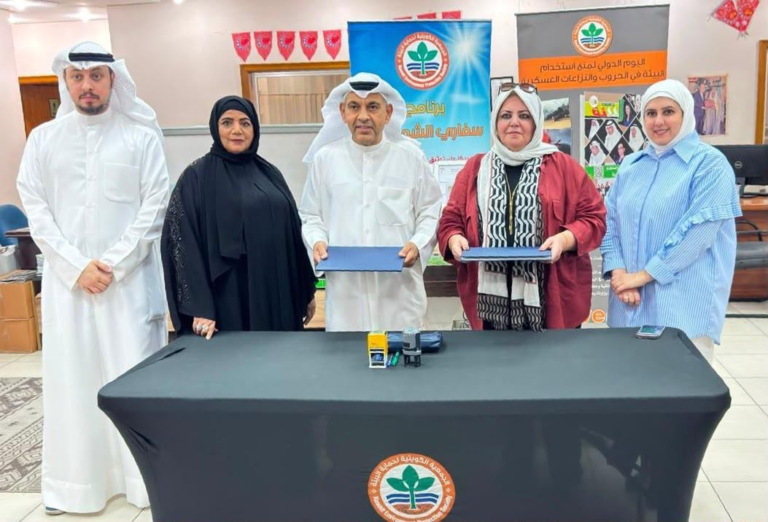
The Sabah Al-Ahmad Center for Environmental Training and the “Green Schools” program of the Kuwait Environment Protection Society, in cooperation with the Ministry of Education, organized an experts’ workshop to discuss the most important issues and topics related to climate change, with the participation of 170 male and female teachers, in preparation for the COP 28 climate summit scheduled to be held in the United Arab Emirates.
Engineer Abdulaziz Al-Muhanna, a member of the Board of Directors of the Environment Society, explained that 17 scientific recommendations were submitted by the teachers, male and female, and technical supervisors at the Ministry of Education who participated in the workshop, noting that these recommendations were submitted to the Minister of Education to be taken into consideration, and that they will also be presented to the experts’ workshops at the COP 27 Climate Summit.
In this regard, Mr. Al-Muhanna said: “Implementing the requirements of green schools and adapting schools to climate change requires considering the increasing environmental challenges and developing strategies to reduce the impact of these changes.” He emphasized that “adapting to climate change requires a joint effort from school administration, teachers, students, and parents, and can contribute significantly to promoting sustainability and preparing for future challenges. Teachers have a pivotal role in building a sustainable generation that understands the importance of preserving the environment and bears its responsibility towards future generations.”.
He pointed out that the recommendations resulting from the experts' workshop were categorized into two main areas: improving the school environment and education and awareness. Regarding the recommendations for improving the school environment, these included: developing emergency plans that take into account the effects of climate change, such as floods or rising temperatures; upgrading and improving school infrastructure to be more resilient to changing weather conditions, such as improving ventilation and cooling systems; adopting building materials that are resistant to changing environmental conditions, thus helping to withstand temperature fluctuations and extreme weather; implementing energy-efficient lighting, cooling, and heating systems to reduce consumption and environmental impact; conducting projects or activities aimed at monitoring and reducing energy consumption within the school; utilizing renewable energy technologies such as solar panels and employing technology to improve energy and resource efficiency, such as using smart lighting and heating systems; establishing school gardens or green spaces to promote sustainability and reduce the impact of heat; and collaborating with the local community and partners to promote environmental practices in and around the school.
Regarding the education and awareness axis, he mentioned “providing environmental education programs for students and employees about the importance of protecting the environment and environmentally friendly practices. Providing and encouraging students and employees to use public transportation. As well as encouraging students to research and innovate in the field of climate change adaptation solutions, and integrating these activities into the curricula.”.
Mr. Al-Muhanna continued presenting recommendations for education and awareness, noting: “Integrating sustainability and environmental protection topics into the curriculum to encourage students to think sustainably and make informed decisions. Utilizing educational resources that focus on environmental and sustainability content, such as documentaries, articles, and relevant books. Supporting creative environmental projects and activities in classrooms, which encourages students to innovate and think about sustainable solutions. Directing positive environmental messages to parents and the community and engaging them, which enhances awareness and participation in sustainability initiatives. Furthermore, encouraging students to consider designing environmentally friendly and innovative buildings in terms of resource utilization and energy technology. Activating and raising awareness of the role of law in protecting the environment within the school by integrating it into the educational curriculum.”.