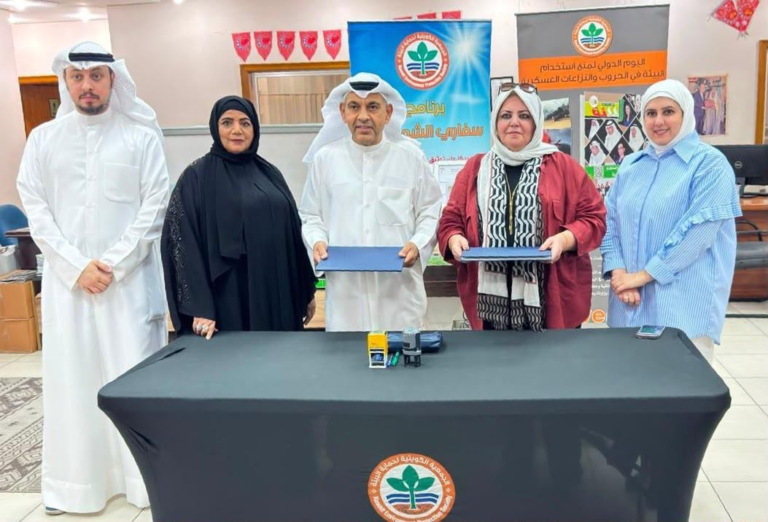
On the occasion of the first anniversary of His Highness the Emir of the country, Sheikh Mishal Al-Ahmad Al-Jaber Al-Sabah, may God protect and preserve him, assuming the reins of power, the Kuwait Environment Protection Society organized a national public campaign within the framework of its awareness program dedicated to the youth and children of the governorate in celebration of the opening of the Red Palace.
M. Maali Al-Aqab, the association’s public relations officer, said, “The included activities included a practical event that focused on raising awareness about the importance of getting rid of plastic bags and replacing them with reusable cloth bags. The cloth bags carried pictures of some wildlife such as the eagle owl and the fox, in addition to the Arabian horse.”.
She added, “In order to encourage social responsibility towards the environment, Adela Al-Baghli, owner and manager of the “Kit Bag” factory for the production of bags and mattresses, provided these bags to encourage children and visitors to use them. Young people and children engaged in coloring drawings expressing living creatures from the State of Kuwait, accompanied by a simplified scientific overview of each living creature included in each bag.”.
While highlighting the advantages of using cloth products as they are better than plastic bags that harm fish and seabirds, Al-Aqab pointed out that “according to some estimates, and with the rate of waste being dumped into the oceans such as cans, cups and plastic bags, after their first use, by 2050 the oceans will carry more plastic waste than fish, and plastic waste will be swallowed by about 99 percent of seabirds. Global waste is expected to grow to 3.40 billion tons by 2050, which is more than double the population growth during the same period, as the total waste generation will more than triple. The growth patterns of waste will have enormous effects on the environment, health and development, which requires taking urgent action. As soon as the consumer thinks about buying, he must be aware of everything that has a direct harm to the environment.”.
She reviewed some of the simple steps that enable everyone to reduce plastic consumption in daily life, including replacing plastic water bottles with reusable ones, making sure to buy reusable or biodegradable materials, and getting rid of plastic bags and other products that cause a great burden on the environment.
Ms. Maali Al-Aqab stated that “working in different directions contributes to environmental, economic and social sustainability, in order to achieve the Sustainable Development Goals for 2030 and to promote the application of laws and support local and international decisions, considering that environmental culture regarding the extent of the harm of plastic and community awareness of alternatives is the solution, because all solutions are available in light of the existence of a law that helps prevent the use of non-environmentally friendly products, and encourages finding alternatives supported by the state for the consumer and the investor so that it is easy to replace plastic with other alternatives.”.