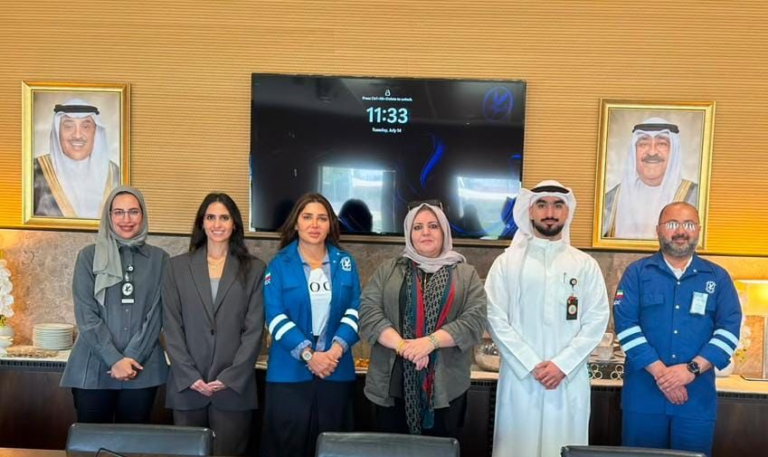
The Kuwait Environment Protection Society announced its views on its participation in the activities of the Third International Conference and Exhibition on Spills, Clean Seas and the Environment (RECSO EnviroSpill), which was recently held under the patronage of His Excellency the Minister of Oil, Tariq Suleiman Al-Roumi. The Society noted that its diverse participation included delivering lectures and chairing scientific and discussion sessions. In this regard, Dr. Wajdan Al-Aqab, President of the Society, highlighted the participation of Eng. Sarah Al-Ramzi, founder and head of the Society's Environmental Engineers Team, in the organizing committees of the conference and exhibition. She also noted that Eng. Al-Ramzi chaired the third track session entitled “Policy and Governance,” in addition to chairing the fourth track session entitled “Impact Analysis and Business Continuity.”.
For her part, Dr. Wajdan Al-Aqab gave a scientific lecture and a visual presentation on “The Environmental Impact of Oil Spills and Communication to Ensure Safety,” during which she reviewed “the environmental impact of oil spills, which is represented in the impact on marine and coastal ecosystems, the impact on wildlife and biodiversity, as well as the long-term environmental impacts and the economic and social impacts.”.
Her presentation addressed the impacts on marine and coastal ecosystems, including coral reefs, which are sensitive ecosystems that can suffer from suffocation and toxicity resulting from oil spills. She also discussed the pollution of beaches and sediments and how toxicity affects microorganisms. She explained the scientific concept of the intertidal zone and how organisms in this zone lose their habitats due to oil spills. She pointed to mangrove forests and wetlands where layers of oil coat the roots of mangrove trees, reducing their ability to exchange gases, which can lead to tree death and long-term damage.
Regarding the impact on wildlife and biodiversity through plankton, she said, “Oil creates a layer on the water's surface, blocking sunlight and affecting the photosynthesis of aquatic plants and phytoplankton.” She then discussed the effects on fish and invertebrates, explaining that direct oil exposure can damage gills and reproductive systems, leading to a decline in bird populations. Oil coats bird feathers, reducing their insulating properties and water-repellent capabilities, resulting in hypothermia and muscle contractions. She also highlighted the impact on marine mammals, noting that dolphins, whales, and seals may inhale toxic fumes or ingest oil-contaminated food, leading to internal damage.
In the context of long-term environmental impacts, the head of the Environmental Society explained that biodiversity loss manifests itself in the potential for vulnerable species to face local extinction due to the combined effects of exposure, habitat loss, and food insecurity. She emphasized that recovery is slow, with some environments, such as Arctic ecosystems, recovering very slowly due to harsh conditions and low rates of biodegradation. In her lecture, she also outlined the economic and social impacts, including those on fisheries and aquaculture, where pollution leads to a decline in fish stocks, impacting commercial fisheries and food security.
Dr. Al-Aqab stated that these effects extend to the tourism sector, with coastal tourism industries suffering due to polluted beaches and marine environments. Furthermore, there are impacts on public health, and direct exposure to oil and toxins can lead to respiratory problems, skin irritation, and long-term health issues in humans.
She emphasized that communication in crisis management encompasses planning, organization, training, equipment, drills, assessment, and situation adjustment. She explained the role of communication in an oil spill crisis through public safety and awareness, informing neighboring communities of health risks and safety precautions. Furthermore, it involves reputation management by addressing public concerns to maintain and mitigate trust. It also includes impact reporting through communication regarding the extent of environmental damage and recovery plans. She highlighted the importance of stakeholder coordination through collaboration between governments, businesses, environmental organizations, and local communities.
In her lecture, she addressed some of her views on the fundamental principles of effective communication during oil spills, including transparency, timeliness, empathy, unity, coordination, and adaptability. She discussed the impact of misleading communication in oil spills, the delayed response (confusion about the severity of the spill leads to ineffective mitigation efforts), and the loss of public trust (inaccurate information undermines the credibility of those in charge). She also addressed the waste of recovery efforts (misinformation leads to the inappropriate allocation of resources).
Dr. Wajdan Al-Aqab stated, “Regarding the communication challenges in oil spill management, the spread of misinformation stands out: myths and rumors about the cause of the spill and the cleanup efforts; media sensationalism: exaggerating facts, leading to panic or misplaced blame; the blame game: disagreements between responsible parties delay finding solutions; and the complexity of technical information: the difficulty of conveying scientific data to the public in an understandable way.”.
The communication strategies for oil spill management were explained, including pre-crisis preparedness where oil spill response plans are developed with communication protocols, and response teams are trained to deal with the media. During the crisis, a central communication center is established and updates are provided through multiple channels (e.g., press releases, social media, and community briefings), and complex information is simplified. Post-crisis communication involves preparing a report on the progress of the cleanup and long-term environmental monitoring, highlighting lessons learned and preventive measures implemented.
Regarding the role of technology in communication during oil spills, Dr. Al-Aqab stated, “Real-time monitoring tools, using scientific techniques, satellite imagery, and drones, are employed to track the spread and impact of the spill. Social media platforms are also utilized to reach a broad audience and address concerns in real time. Community alert systems are used, providing direct notifications to affected areas via SMS or mobile applications.”.
Dr. Wajdan Al-Aqab concluded by reviewing a national success story through the participation of the Kuwait Environment Protection Society in the Eagles Resolve 2015 exercise. “This exercise was the thirteenth edition and the first to include the participation of civil entities. The Kuwait Environment Protection Society proposed the establishment of a civil crisis management unit within the units participating in the exercise.”.